

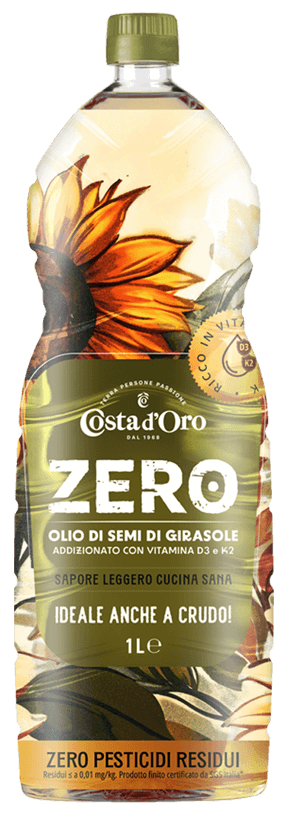
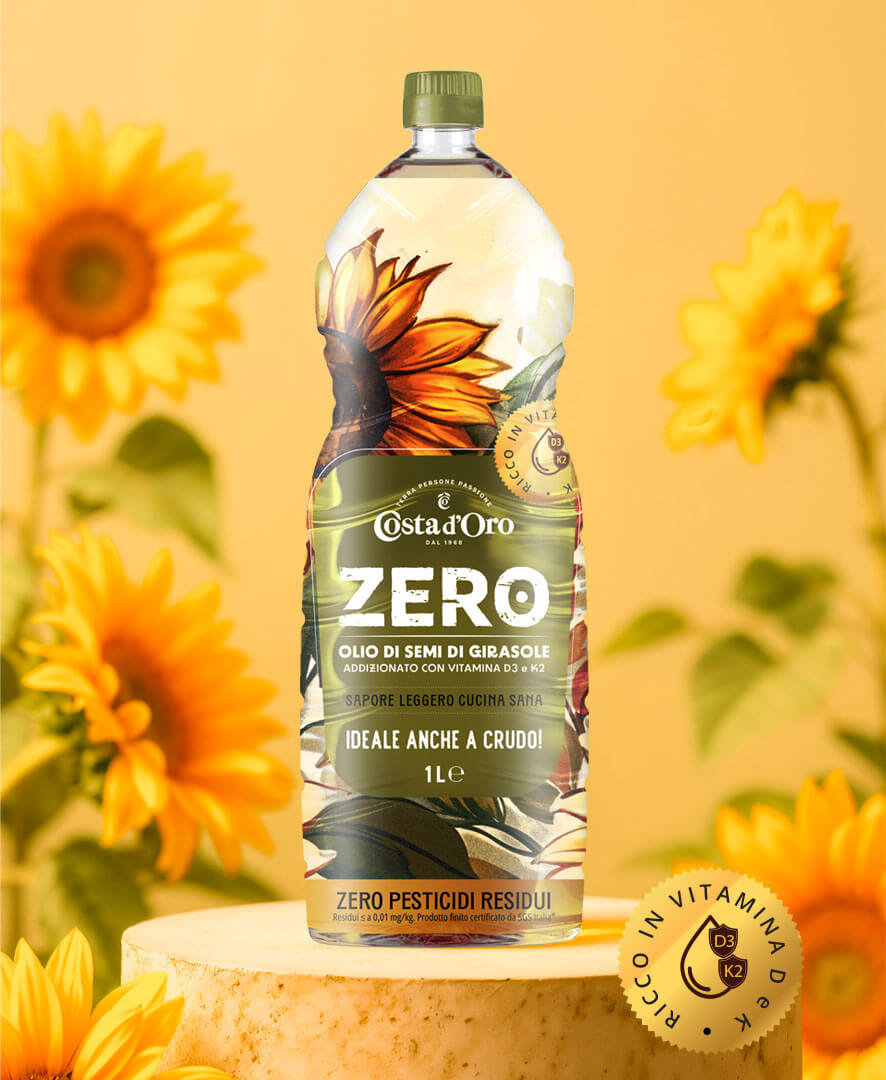


Perfect for pan-frying, ensuring golden and irresistible results, but also great when used raw as a health ally thanks to vitamins D and K.
Ideal for a light, nutritious, and flavorful touch!
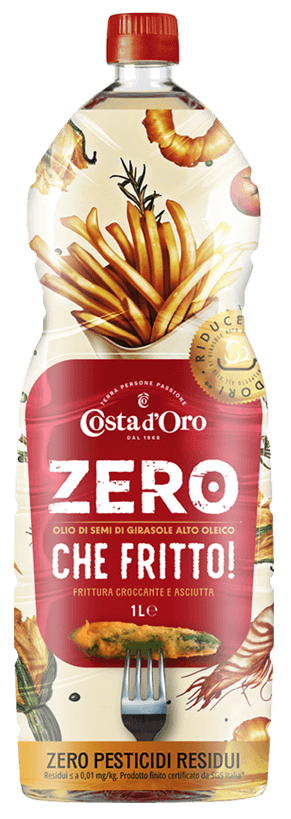
For crispy, dry, and light frying!
Ensures optimal performance thanks to its high oleic acid content.
The list of considered molecules was compiled based on:
The list is reviewed annually and updated whenever any of the involved parties deems it necessary.
faq
“Zero Pesticide Residues” means that none of the researched pesticides have been detected above the quantification limit of 0.01 mg/kg (limit chosen in accordance with the indications of Reg. 396/2005 and subsequent amendments).
A residue is the trace of a chemical substance that can remain in plant products after the use of crop protection products during cultivation, used to defend against pests, diseases, or weeds. These residues are regulated to ensure they remain below levels considered safe for human health.
The selected molecules were identified based on three criteria:
The list is reviewed annually and updated whenever any of the involved parties deems it necessary.
The Limit of Quantification (LOQ) is the lowest concentration at which a substance can be quantitatively measured with accuracy and reproducibility.
Costa d’Oro’s LOQ threshold is set at 0.01 mg/kg – equivalent to 0.000001% – in accordance with EU Regulation 396/2005.
As Costa d’Oro and part of the Avril Group, we believe in actively supporting sustainable agriculture.
We’ve launched a product that exceeds standard requirements in terms of quality and safety, raising awareness for biodiversity protection.
Yes, it complies with a specification certified by SGS Italy.
This specification requires adherence to stricter quality control standards than those already in place at Costa d’Oro.
This includes analysis of all pesticides listed in the specification by accredited external laboratories, a specific and reinforced control plan, and a procedure to verify the reliability of our internal lab’s results through comparison with those of external accredited laboratories.
The specification was developed in collaboration with the certification body SGS Italy.
In analytical chemistry, absolute zero is never used to describe quantity. Measurements always refer to the detection limits of the analytical method.
Our commitment to “ZERO” means remaining below the LOQ of 0.01 mg/kg, as defined by Regulation (EC) No 396/2005.
Yes, farms are permitted to use authorized pesticides on sunflower crops, within legally defined limits.
Both are certified by third-party bodies, but they follow different approaches:
FRYING TESTS
The performance of “ZERO CHE FRITTO” was verified through dedicated testing, comparing it with standard high-linoleic sunflower oil.
The tests were conducted in collaboration with the Department of Agricultural, Food and Environmental Sciences at the University of Perugia.
Results for “ZERO CHE FRITTO” High Oleic Sunflower Oil confirmed not only improved thermal stability, but also a reduction in harmful compounds that can form during frying (such as acrolein) and a reduction in volatile compounds responsible for unpleasant odors.
